
Short answer: AI has already taken over the early, cheap, fast parts of fashion development — research, inspiration, concept visuals, and communication. The expensive, physical parts — fabric selection, pattern making, production judgment, quality control — remain stubbornly human, because cloth doesn't care about your prompt. The brands winning with AI aren't the ones letting it "design." They're the ones using it to arrive at the factory door better prepared.
Some context on how fast this moved: in McKinsey and Business of Fashion's State of Fashion survey, 73% of fashion executives called generative AI a priority for their business — but only 28% had actually tried it in design and development, and just 5% felt ready to use it at scale. That gap between "priority" and "actually using it" is where most brands sit right now. It's also your opportunity, because the bar for being ahead of the curve is still remarkably low.
What AI is genuinely good at
1. Market research at a speed interns can't match
Feed an AI tool fifty product pages from competitor brands and ask for patterns: price bands, fabric specs mentioned, review complaints that repeat. Twenty minutes later you have a structured summary that would take a person a week. Is it perfect? No. You'll still need to verify anything that matters. But as a first pass over a market you're about to enter, it's absurdly efficient. This is the least glamorous AI use case and probably the most valuable one for a new brand.
2. Moodboards and concept exploration
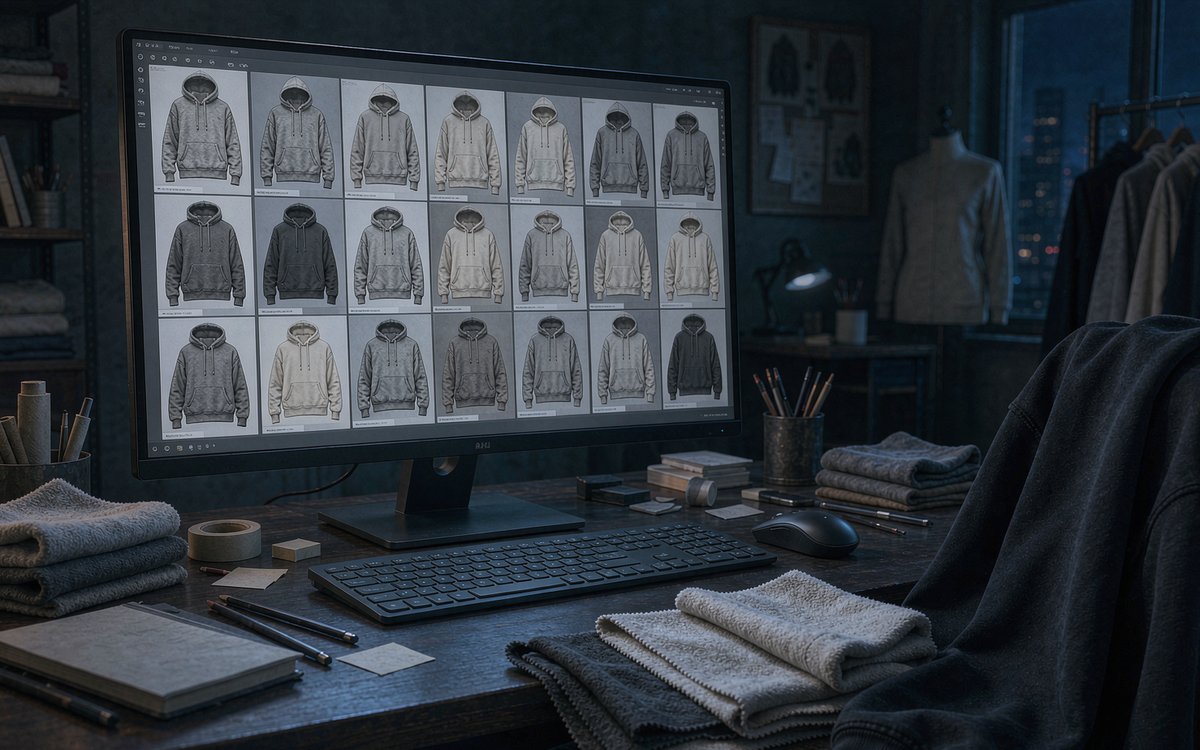
This is where image generation earns its keep. A founder describing "washed charcoal heavyweight hoodie, boxy, dropped shoulders, small tonal chest embroidery, late-90s workwear feel" can see forty visual interpretations of that sentence in an afternoon. Before AI, exploring that many directions meant weeks of sketching or hiring a designer on spec. Now the exploration phase costs nearly nothing, which means you can afford to be picky. Generate wide, then kill most of it. The taste is still yours — AI just made the raw material free.
3. Product visualization before you spend on samples
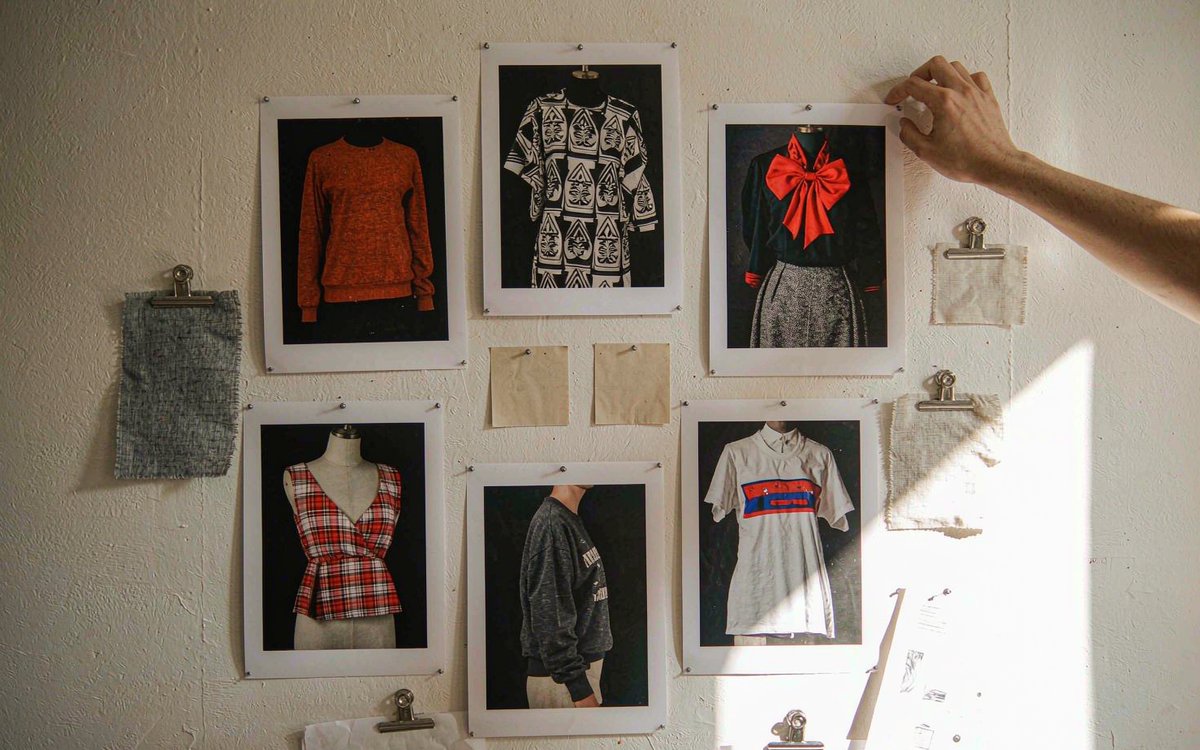
Colorway testing used to mean strike-offs and sample yardage. Now you can render your hoodie in eight colorways, put them in front of your audience, and let pre-orders or poll data decide which three actually get made. We've watched clients kill colorways this way that they would have paid to sample two years ago. Every sample round you skip is real money — sampling runs from days to weeks per round and the costs stack.
4. Clearer communication with manufacturers
This one surprises people, but as a factory we feel it directly. Clients now arrive with AI-generated reference images showing the exact wash effect, the print placement, the fit intent. A picture of what you want beats three paragraphs of adjectives, every time. Combined with AI translation and spec-drafting tools, the language and documentation barrier that used to make overseas manufacturing intimidating has mostly dissolved. The projects that go smoothest are still the ones with precise input — AI just made precise input much easier to produce.
What AI cannot do (and won't for a while)
Now the other side, because this is where brands get hurt.
Fabric knowledge
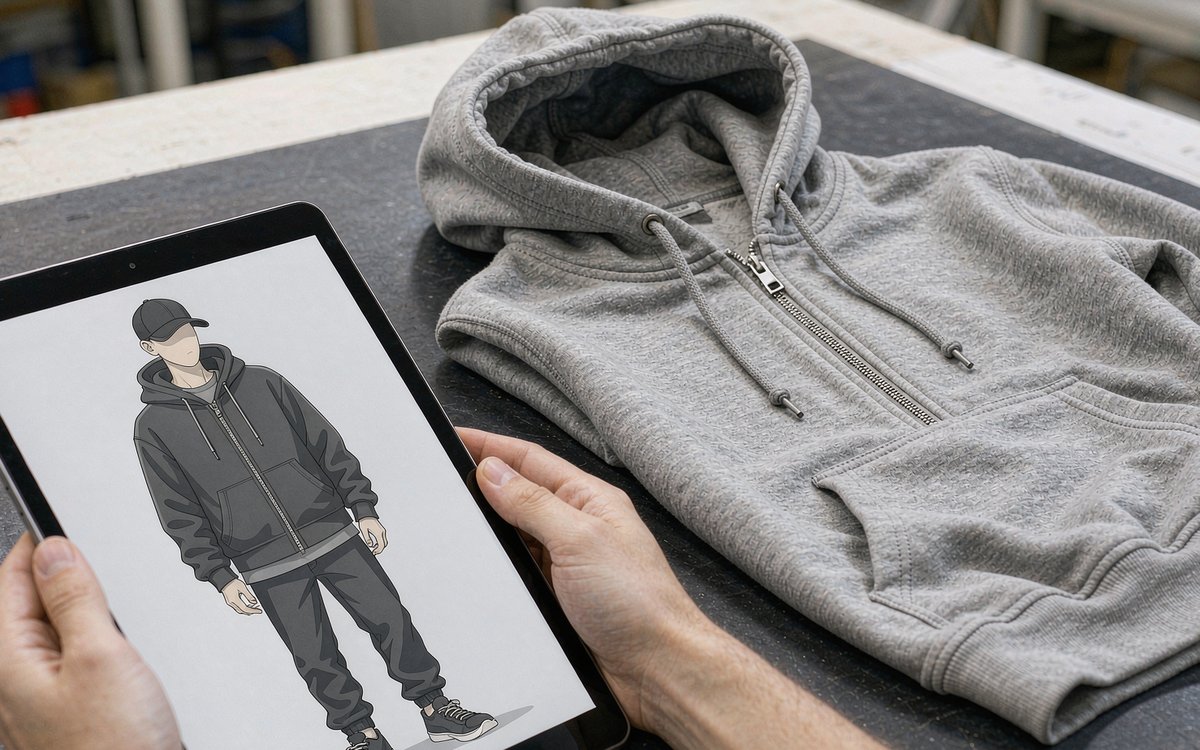
An AI image cannot tell you that the drape it just rendered requires a 500gsm loopwheel fleece with a specific yarn twist, or that the wash effect it drew will look completely different on a cotton-poly blend than on 100% cotton. Fabric is physics. Two cloths at the identical weight can behave like different materials — one dense and architectural, one soft and collapsing. Knowing which one your concept needs, and what to ask a mill for, is accumulated tactile knowledge. AI has read about fabric. It has never pulled a hoodie out of a wash drum and felt what the process did to it.
Pattern making
AI renders the outside of garments. Patterns are the inside — the two-dimensional engineering that decides whether a shoulder sits clean or collapses, whether a sleeve twists, whether "oversized" looks intentional or just wrong. An AI image gives no measurements, no seam logic, no grading rules. Converting a beautiful render into a pattern that actually sews is a skilled human job, and it's where most AI-generated "designs" quietly die.
Manufacturing judgment
Can this embroidery density go on this jersey without puckering? Will this print survive the wash the design calls for? Is this seam construction possible at your price point, on standard machines, at 500 pieces? These questions decide whether a design is a product or a fantasy, and the answers live in production experience, not in any dataset AI trains on. This is also why AI renders need a technical review before they become tech packs — we've received gorgeous AI concepts that were physically unmakeable as drawn, and part of our job is telling clients which fifteen percent needs to change.
Quality control
No further explanation needed, honestly. Until AI can stretch a printed panel, measure a shrunken chest width, or spot a needle hole in a seam, somebody's eyes and hands own the last word on quality. That somebody is human.
The workflow that actually works in 2026
Here's the pattern we see in clients who use AI well:
Notice what AI did: it compressed weeks of exploration into days and killed bad ideas before they cost sample money. Notice what it didn't do: touch a single physical garment. That division of labor — AI accelerates creativity, professional manufacturing turns ideas into real products — is the honest summary of 2026.
Frequently asked questions
Can AI design a whole clothing collection for me?
It can generate images that look like a collection, yes. What it can't do is make them producible: no measurements, no fabric logic, no construction awareness. Treat AI output as a very fast, very talented mood intern whose work always needs a technical review before a factory can use it.
Do I own AI-generated designs?
Murky territory, and worth taking seriously. In the US, the Copyright Office has said purely AI-generated images aren't copyrightable — only the human-authored parts are. Other jurisdictions differ. Practically: the more you modify and direct (your sketches, your specs, your combinations), the stronger your position. And trademark your brand name and logo regardless — that's the protection that actually matters commercially.
Will AI replace fashion designers?
It's replacing the version of the job that was "produce twenty variations by Friday." It's not replacing the version that's "decide which two variations deserve to exist and why." Designers with taste, fabric knowledge, and production awareness are becoming more valuable, because the raw output they have to work with just got a hundred times bigger.
Can a factory work directly from my AI images?
Often, yes — as reference input. We regularly develop samples from client AI renders combined with measurements and fabric direction. What we can't do is sew the image itself: expect a technical conversation about what's feasible, what needs adjusting, and what the render got physically wrong. Send the images. Just don't skip the conversation.
What's the biggest mistake brands make with AI design?
Falling in love with the render. AI images are lit, styled, and textured by a machine optimized for beauty, not accuracy — real garments under real light always look different. Brands that treat the render as a promise end up disappointed with perfectly good samples. Treat it as a direction, and the process works.
Conclusion
AI didn't change what makes a clothing brand work — positioning, product, quality, and a supply chain that delivers. It changed the cost of getting started, and it changed it dramatically. Research that took weeks takes hours. Concept exploration that took a designer's month takes an afternoon. Communication with a factory on the other side of the world got ten times clearer.
But the last mile is still made of fleece, thread, and stitch counts, and it still rewards people who know those things deeply. Use AI for everything it's good at. Then bring the survivors to people who can actually build them — we do that part.