
Short answer: clothing brands rarely fail because of bad designs. They fail because of bad sequencing — too many products, suppliers chosen on price alone, no testing, and inventory math that never had a chance. We've been manufacturing streetwear in Dongguan since 2007, and we've had a front-row seat to both outcomes. The brands that vanished made remarkably similar mistakes. Here are the ten we see most, in roughly the order they happen.
Mistake 1: Starting without clear positioning
"Streetwear for everyone" is not positioning. It's the absence of one. When a new brand can't tell us who their customer is, we can predict their first collection before they send it: a bit of everything, aimed at no one, memorable to nobody. The fix costs nothing — one sentence naming your customer and what you believe about clothing that competitors won't act on. Brands that skip this sentence spend the next two years and most of their budget learning why it mattered.
Mistake 2: Copying existing brands
We can spot these instantly. A tech pack arrives that is, no exaggeration, a famous brand's hoodie with a different logo. Here's the problem: the original brand sells theirs at that price because of ten years of audience trust. You have none of that trust and the same product. Why would anyone buy yours? Inspiration is normal — every designer references. But if your brand disappears when you remove the reference, you don't have a brand yet. You have a tribute act.
Mistake 3: Creating too many products
This is the single most common killer we see. A founder with a $15,000 budget designs fifteen styles. That budget now buys maybe 30-50 pieces per style, in one colorway, with nothing left for marketing, reshoots, or the reorder when something actually sells. Fifteen styles also means fifteen patterns, fifteen sets of trims, fifteen things that can go wrong in production. The brands that work do the opposite: three to five styles, enough depth per style to actually sell through, cash left over to restock the winner. Constraint isn't a limitation. It's the strategy.
Mistake 4: Ignoring product quality
Some founders treat the garment as packaging for the logo. Customers notice — not on day one, but on wash three, when the print cracks and the collar waves. In streetwear specifically, your customer is unusually fabric-literate. They weigh hoodies in their hands. They check stitch density. They know what 400gsm should feel like. A brand built on a clever graphic and a flimsy blank gets exactly one purchase per customer. Quality isn't a premium feature in this category; it's the entry ticket.
Mistake 5: Choosing suppliers only by price
Two factories quote you for the same hoodie: $9 and $13. The $9 quote is not $4 of savings — it's a different product. Cheaper fabric (lower grade yarn, less dense knit), fewer QC steps, unlisted extras that appear on the final invoice, and a sample that somehow looks better than the bulk. We're not saying expensive is automatically good. We're saying that when a quote is dramatically below the others, the missing money has to come out of the garment somewhere, and it always does. Compare quotes line by line — fabric weight, yarn type, print method, finishing, packaging — before comparing the totals.
Mistake 6: Not testing products
A founder once told us he skipped the second sample round to save three weeks, because the first sample "looked fine in photos." The bulk order of 300 pieces came back with a hood that sat wrong and a print two inches too low. Photos lie. Samples exist because fabric behaves in three dimensions and on actual bodies. Wear the sample. Wash it ten times. Give it to people in your target size range and watch them move in it. Two extra sample rounds cost a few hundred dollars. A failed bulk run costs the brand.
Mistake 7: Poor inventory planning
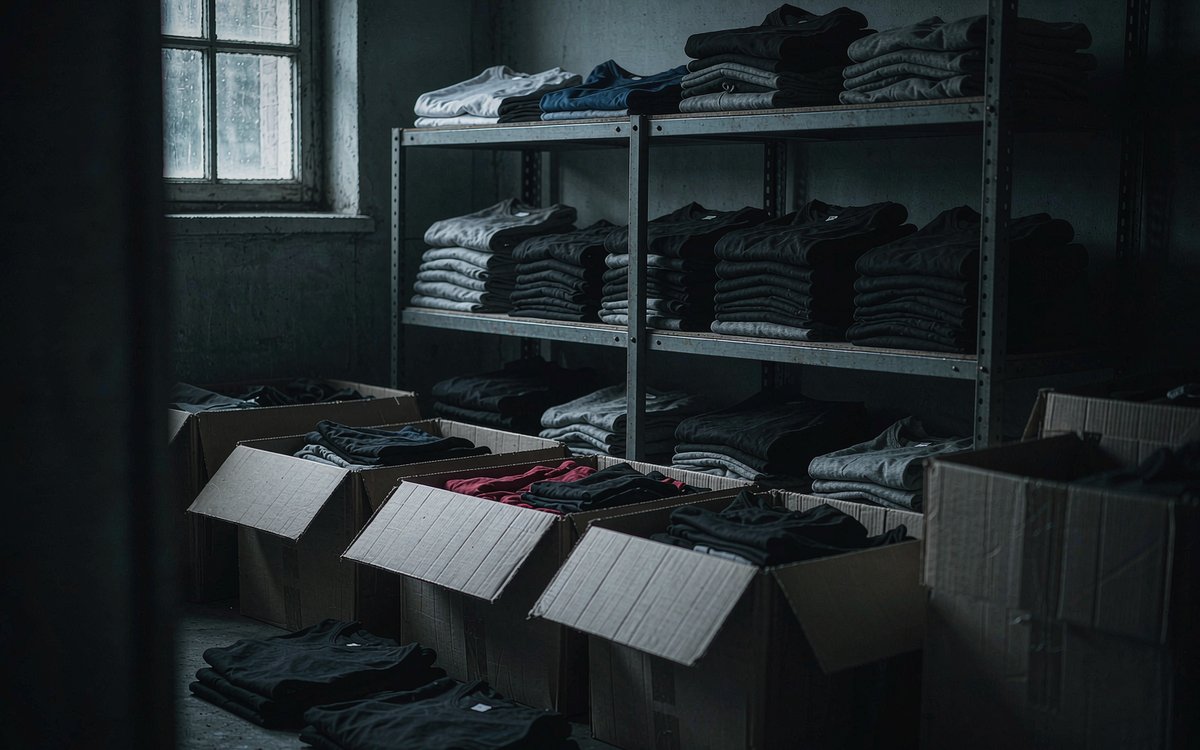
Inventory is where clothing brands' cash goes to die. The pattern: a founder orders deep on every size and color to "be safe," sells through the medium and black in three weeks, and sits on green XXL forever while having no cash to restock what's actually selling. Dead stock isn't just wasted money — it's money that can't buy the next order. Start shallow (50 pieces per style per color is a reasonable floor for custom work), track sell-through by SKU, and let restock speed, not order depth, protect you from selling out.

Mistake 8: No consistent brand identity
Drop one is minimalist heavyweight basics. Drop two is all-over anime print. Drop three is Y2K denim. Each drop might be fine on its own, but together they tell customers nothing about who you are — and worse, each drop attracts a different audience that won't buy the others. Consistency doesn't mean repeating yourself. It means every release is recognizably from the same hand: same fit philosophy, same quality bar, same visual language evolving slowly. Brands are built by accumulation. Random resets burn the accumulated trust.
Mistake 9: Ignoring customer feedback
The most expensive sentence in this industry is "customers don't get it." They get it perfectly — they're telling you the sleeves run short, the fabric pills, the size chart lies. Every return, every DM, every review is product development data you already paid for. The brands we see grow fastest treat their first fifty customers like a focus group: they ask, they listen, they adjust the next batch. The ones that fail treat feedback as an insult to their vision. Vision without adjustment is just stubbornness with a logo.
Mistake 10: Scaling too quickly
One drop sells out. Confidence surges. The founder triples the order, adds five new styles, signs up for a trade show, and starts a second line. Then the second drop — which sold out partly because of first-drop novelty — sells normally, and the brand is suddenly sitting on triple inventory with fixed costs it can't carry. Selling out once proves a moment. Selling out twice, with the same styles, proves a pattern. Scale on patterns, not moments. Boring advice. It's also the advice that keeps brands alive.
Frequently asked questions
What is the number one reason clothing brands fail?
Cash flow, almost always — and inventory is usually what breaks it. Brands tie up their entire budget in too many styles and too much depth per style, then can't afford to restock what sells or market what doesn't. The design is rarely the fatal problem; the math is.
How many clothing brands survive their first year?
Reliable industry-wide numbers are hard to pin down, but general small-business data consistently shows a large share of new retail ventures don't make it past year two, and fashion is harsher than average because of inventory risk. The brands that survive tend to share the same traits: small first collections, tested products, and conservative ordering.
Is it a mistake to start a clothing brand with no fashion background?
No — some of our most successful clients came from marketing, music, or completely unrelated fields. What they had in common was humility about the technical side: they asked factories questions, listened to pushback on construction and fabric, and didn't confuse a strong Instagram aesthetic with production knowledge. Lack of background is fine. Lack of curiosity about it isn't.
How do I know if my supplier choice is a mistake?
Early warning signs: quotes that arrive suspiciously fast with no questions asked, samples that look better than the fabric spec suggests, reluctance to show production photos, and yes-men who never push back on anything. A good manufacturer asks annoying questions before taking your money. Silence is not professionalism.
Can a failed clothing brand recover?
Yes, and many do — usually by doing less. The recovery pattern is nearly always the same: liquidate the dead stock at whatever it brings, cut the range back to the two or three pieces customers actually bought, fix the quality issue that generated returns, and relaunch small. The brand equity survives a pause far better than it survives a second bad batch.
Conclusion
Read back through the ten and you'll notice something: nine of them are decisions, not luck. Positioning, range size, supplier criteria, testing, inventory depth, scaling speed — all of it is chosen before the money is spent. That's the good news. You can simply choose differently.
The thread connecting most of these mistakes is trying to look like a big brand before earning it. The brands that make it accept being small first: few styles, low minimums, honest testing, tight cash control. If you want a manufacturing partner who'll tell you when your plan has one of these mistakes in it — before production, not after — that's a conversation worth having.